
Fleming County Deed Record Types
Conveyance forms vary across Fleming County deed records. The instrument label shapes how a transfer should be read. An index row never tells the whole story. Only the deed image supplies the operative language and the legal description. It also shows signatures, acknowledgments, consideration terms where shown, and prior references. Read it alongside the other recorded instruments touching the parcel.
| Deed type | What it does | Typical research use |
|---|---|---|
| Warranty deed | Conveys the stated interest with deed covenants | Ordinary purchase chain |
| Quitclaim deed | Transfers whatever interest the grantor has, if any | Family or ownership cleanup |
| Executor or fiduciary deed | Conveys under estate or representative authority | Probate-linked transfer |
| Commissioner deed | Records a court-directed conveyance | Judicial sale or partition trail |
| Sheriff or tax-related deed | Records a transfer tied to statutory proceedings | Delinquency or enforcement research |
A mortgage secures a debt rather than conveying ownership the way a deed does. Liens, easements, assignments, and releases still shape the parcel's recorded history. Search them by party and land clues. Do not stop at the latest deed.
Fleming Deed Coverage Has Layers
The Fleming County Clerk reports courthouse custody from 1795 to the present. Most document indexes begin in 1880, with exceptions. Filing images, though, are described as reaching back to January 1795. Those statements cover different layers of access. So an early image can exist even when a modern name index does not point straight to it.
Start from a known book and page, a current deed, or an assessment-card reference. When the online path breaks, turn to the office books. Also lean on clerk assistance, KDLA microfilm, and the library's local collection. Preserve the source type and the page image, never just a typed index result.
Note: Treat 1795 image coverage and 1880 index coverage as separate facts when planning a Fleming deed search.
Fleming eCCLIX Deed Access
eCCLIX serves as the clerk's online index and image route. Registering takes a full personal profile: name, street address, city, state, ZIP, email, phone, county, username, password, and a confirmation. The clerk describes five daily searches for qualifying personal, noncommercial Fleming research. The vendor signup lists a zero fee, weekday-only access hours, and no weekend access, so confirm the live terms before relying on any of it. The public eCCLIX registration page shows the account gate that stands before a Fleming search.
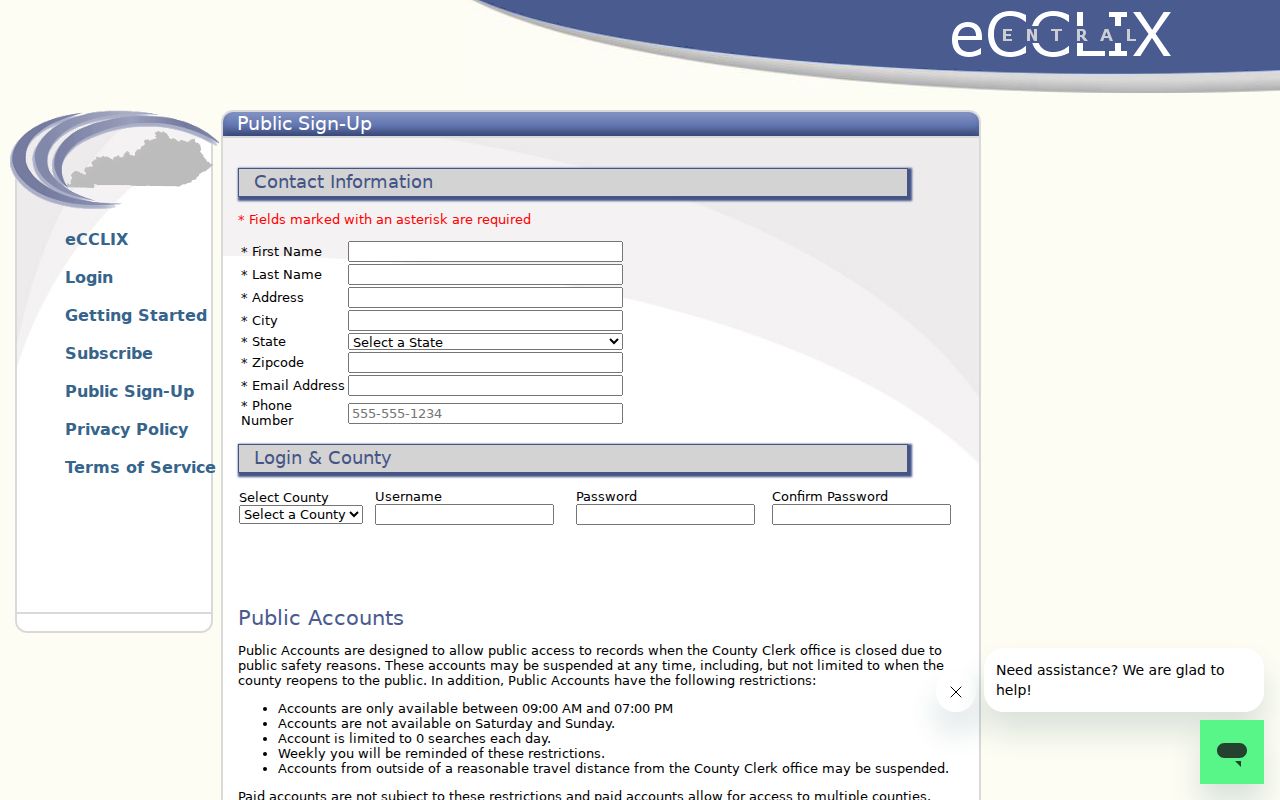
The county field and personal account details mark an access request, not a search result. The registration path produces no Fleming index view. The actual index fields and image status must be transcribed after login or with clerk help.
Work Fleming Grantor-Grantee Indexes
A grantor transfers an interest. A grantee receives it. Both roles matter, because one owner enters the chain as grantee and later leaves it as grantor. Start from the newest recorded deed that matches the parcel, then work backward through the prior party and every cited reference.
- Locate the present acquisition deed by searching the current assessment name as grantee and checking variants.
- Open the image and copy the grantor, grantee, legal description, dates, book/page, document number, and prior deed reference.
- Search that grantor as a grantee in the earlier period. Confirm the same land rather than relying on a shared surname.
- Repeat each prior reference. Check heirs, commissioner, sheriff, estate, and business-name entries when the ordinary chain breaks.
- Move to deed books, microfilm, or clerk assistance where the electronic index no longer provides a reliable path.
- Grantor
- The party transferring the stated interest.
- Grantee
- The party receiving the stated interest.
- Chain of title
- The ordered series of instruments affecting ownership.
- Book/page
- A volume and page citation used to retrieve an older record.
- Instrument number
- A filing identifier that may serve as the newer retrieval key.
Fleming Index Searches Need Variants
Names shift across Fleming deed records. Search surname-first and in natural order. Try initials and full names. Also try ampersands, former names, estate terms, trustee or fiduciary capacities, and corporate suffixes. For a business, check the exact legal name plus inactive names through Kentucky's business search. Then compare the deed grantee. A registered agent is not the owner simply because both names surface in public files.
KDLA's deed-research method suggests checking H for heirs, C for commissioner, and S for sheriff. These apply when ordinary grantor and grantee entries fail. Probate, a will, a court order, or a power of attorney can explain a transfer. Such a transfer may not read like a routine sale. Keep the related case or will citation beside the land record. It does not substitute for the recorded conveyance.
Note: Copy every spelling exactly before creating variants. A corrected search term should never erase the wording of the source.
Read Fleming Deed Images Fully
Treat an index row as a locator. The deed image is the fuller record. Capture the document type, all parties and capacities, instrument date, recording date, book/page or instrument number, consideration language where present, legal description, exceptions, easements, signatures, acknowledgment, and cited prior instruments. Note every page in a multi-page filing.
Compare the legal description with the qPublic card and map. One deed can cover several tracts even when the PVA now shows separate cards. A card may also abbreviate a description as part of or see plat. A later parcel split is not automatically a later conveyance, and the recorded plat with parent and child parcel references helps reconcile the change.
A Fleming sample assessment card lists a zero-price close-relative sale. That is a transfer event, not an arm's-length comparable. Preserve the reason and qualification beside the date. Never read zero as proof that no conveyance occurred.
Scan the image for reservations and exceptions. Mineral language, an easement, a retained life estate, or an excluded tract can change what the party index seems to say. Follow each cited plat, prior deed, release, or related instrument that matters. If handwriting, a poor scan, or an abbreviated legal call stays unclear, compare the office book or request a better copy instead of silently supplying text.
Old Fleming Deed Books Persist
Deep chain work eventually pushes past the web portal. The KDLA microfilm inventory offers a statewide finding route for old Fleming County deed books, and record requests through KDLA cover deeds plus related record families. Costs run $20 for in-state orders and $25 out of state, nonrefundable, with copies, scans, and postage extra. Turnaround typically stretches four to six weeks. Confirm current terms before ordering.
Two other channels help. The Fleming County Public Library holds non-circulating genealogy books, family files, newspapers, and microfilm. FamilySearch carries a Kentucky wills-and-deeds full-text collection, though image rights may limit viewing away from an approved location. Treat these as discovery tools. The county clerk stays the custodian of any official copy.
A rare warning sits in the local finding aid. Some index-volume bindings and filming targets are wrong even when the cataloging looks right. Before declaring a gap, check the front name index, the business pages at the end, the neighboring reel, and the actual image sequence. Gaps sometimes vanish on closer inspection.
Fleming DOC ALERT Watches Filings
The clerk offers a free DOC ALERT signup. It needs only a name and email address. Once enrolled, a notice goes out whenever a deed or mortgage is recorded. It bears that personal or business name. Owners, estate representatives, and companies all use it to flag filings that merit review.
The alert has limits. It does not block a document, verify identity, or judge validity. A legitimate mortgage, release, corrective deed, or same-name filing can all trigger a notice. Open the image and match the parcel, the parties, and the instrument type. If a document seems unfamiliar, preserve the alert and contact the clerk promptly.
Enroll every deed-name form that matters. Then check each notice against the actual filing before drawing conclusions.
Order a Fleming County Deed
Copies come three ways. Use the online image route, visit the clerk counter, or mail a request. The published schedule lists self-made office copies at $0.50 per page. Mailed copies run $1 per page, and certified copies run $5 per page. Give the clerk the party names and approximate date. Include the document type, book/page or instrument number, and a property clue. Ask for the total before sending payment, since fees can change.
Recording charges are a separate matter. The clerk's schedule lists representative filing fees, such as $50 for a deed, easement, or plat. Page surcharges apply on marked instruments beyond stated limits. Someone retrieving an existing deed needs the copy schedule. That person does not need the fee for recording a new instrument.
A certified copy authenticates the custodian's reproduction. It says nothing about whether title is clear. For a wider search, the Fleming County property lookup process helps identify the parcel. Order the specific instrument after that. Mail requests should state a return address and the desired copy type. Telephone confirmation helps when a document spans many pages or a prior citation looks shaky. A self-made counter copy may cost less, but certification still follows the clerk's process. Keep the receipt. Label the file with the county, record type, book/page or instrument number, and the date obtained. That habit keeps an index printout from being mistaken for the deed itself.
Recorded, not guaranteed. Fleming County deed records show filed instruments. Unrecorded interests can exist, and the index is not a title opinion.